


As much as we’d like to think that we’re entering an era of autonomous robots, they’re actually still pretty helpless. To keep them from falling down all the time, a human’s fast reflexes could be the solution. But the human has to feel what the robot is feeling — and that’s just what these researchers are testing.
Bipedal robots are excellent in theory for navigating human environments, but naturally are more prone to falling than quadrupedal or wheeled robots. Although they often have sophisticated algorithms that help keep them upright, in some situations those just might not be enough.
As a way to bridge that gap, researchers at MIT and the University of Illinois-Champaign put together a sort of hybrid human-robot system reminiscent of either Pacific Rim or Evangelion, depending on your nerd alignment (or Robot Jox, if you want to go that way).
Although the references may be sci-fi, the need for this kind of thing is real, explained U of I’s João Ramos, co-creator of the system with MIT’s Sangbae Kim.
“We were motivated by watching the 2011 Tohoku, Japan, earthquake, tsunami and subsequent Fukushima Dai-ichi nuclear plant disaster unfold. We thought that if a robot could have entered the power plant after the disaster, things could have ended differently,” Ramos said in a U of I news release.
The robot they created is a small bipedal one they call Little Hermes, and it is hooked up directly to a human operator, who stands on a pressure-sensing plate and wears a force-feedback vest.
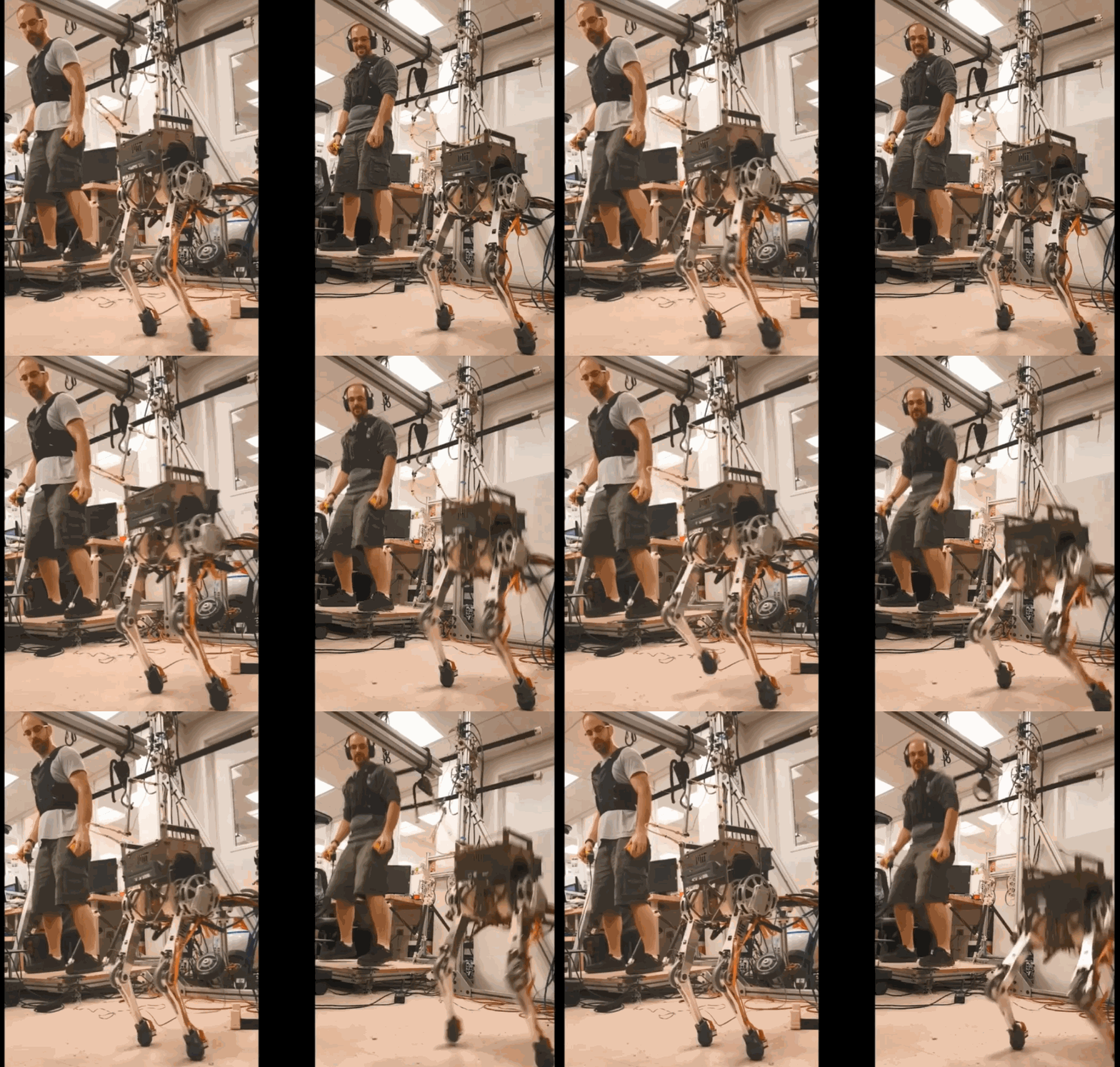
The robot generally follows the operator’s movements, not in a 1:1 sense (especially as the robot is much smaller than a person), but after interpreting those movements in terms of center of gravity and force vectors, makes a corresponding one almost simultaneously. (The MIT writeup goes into a bit more detail, as does the video below.)
Meanwhile, if the robot were to, say, encounter an unexpected slope or obstacle, those forces are conveyed to the operator via the vest. Feeling pressure indicating a leftward lean, the operator will reflexively take a step in that direction using those excellent instincts we animals have developed. Naturally the robot does the same thing and, hopefully, catches itself.
This feedback loop could make on-site rescue robots and others on uncertain footing more reliable. The technology is not limited to legs, though, or even to Little Hermes. The team wants to set up similar feedback systems for feet and hands, so mobility and grip can be further improved.
The team published their work today in the journal Science Robotics.
(techcrunch)